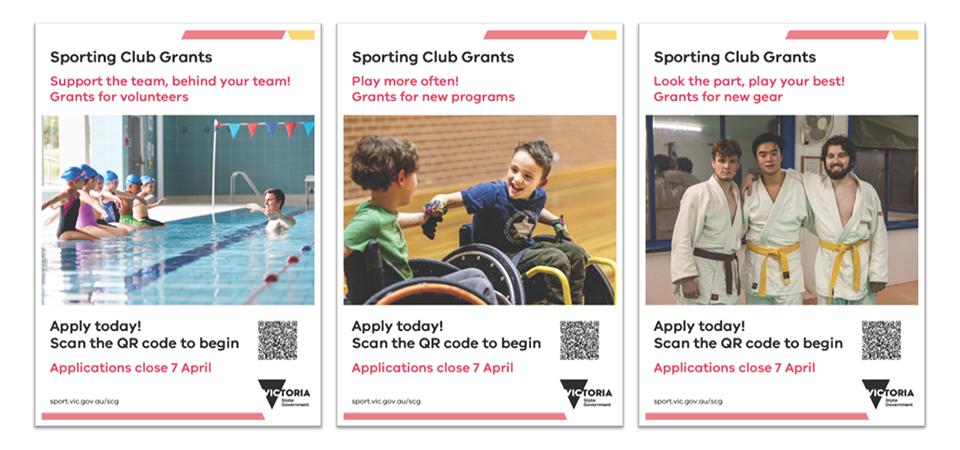
- Funding categories
The program has four funding categories:
Category 1: Uniforms or Equipment
Grants up to $1000 to purchase uniforms or equipment, including first aid equipment, essential for participation.
Category 2: Skill Development
Grants to improve the skills of club members by providing training for coaches, officials, administration staff and management committees.
- Up to $2,000 for individual organisations.
- Up to $5,000 for leagues, associations or an organisation that collaborates with multiple organisations to deliver training for a broad range of participants.
Category 3: Club Operational Capacity
Grants up to $5000 to improve the operational effectiveness and efficiency of clubs through strategic planning or, to increase community participation through accessible sport and active recreation opportunities such as pilot programs.
Category 4: Aboriginal Participation
Grants of up to $1000 for uniforms, equipment, up to $2000 for skills development training and up to $750 for travel.
- What types of activities might be funded?
Category 1: Uniforms and Equipment
The purchase of sporting uniforms or equipment that is essential for participation, safety, or first aid equipment for immediate attention to injury that may occur participating in sport or active recreation.
Eligible items may include but are not limited to:
Uniforms, for example:
- jumpers
- tracksuits
- socks
- boots
OR
Equipment, for example:
- bats
- match balls
- team equipment kits
- first aid equipment
- protective equipment including gloves, helmets and batting pads.
Category 2 : Skill Development
Initiatives to improve the skills of club members and club sustainability through training for coaches, officials, administration staff and management committee members.
Examples of initiatives may include but are not limited to:
- participation in courses for coaches, referees, umpires and officials. This includes sports first aid and sports training level 1 or 2
- workshops for administrators and committee members in financial management, governance and committee management, volunteer management, club administration, information technology or Member Protection Information Officer training.
Category 3 : Club Operational Capacity
Initiatives to improve the operational effectiveness and efficiency of organisations. Additionally, initiatives such as a pilot program to increase community participation through accessible sport and active recreation opportunities.
For example:
- preparation of a business plan / strategic plan / succession plan
- development of policy and procedure manuals
- development of a club or organisation website
- start-up costs associated with the development of sport and active recreation programs, such as an alternative, modified or pilot programs, that aim to increase the equity, diversity and inclusiveness of sport and recreation for low participation groups or increase the membership base for clubs. This can include promotional material, equipment, uniforms, and training
- promotional materials, such as Aboriginal-specific club information flyers or information in other languages.
Category 4 :Aboriginal Participation
- the purchase of equipment that is essential to participation in sport or active recreation or required to develop programs that will provide opportunities for Aboriginal Victorians to participate in sport and active recreation
- travel and accommodation costs over a 12-month period for athletes, coaches, officials or teams that are required to travel to train or compete. For example, an athlete or team that is regularly required to travel to train, or a regional club that is required to travel to a number of other towns in order to compete in their local competition or carnivals
- initiatives to improve the skills of the Aboriginal community members/volunteers of an organisation that is targeting increasing participation in sport and active recreation for Aboriginal Victorians. For example, coaching, administration and committee management.
The purchase of uniforms and equipment, travel and accommodation costs and training for coaches, officials, administration staff and management committee members which increase participation by Aboriginal Victorians.
For example:
- What will not be funded?
The Sporting Club Grants Program will not fund the following:
- more than one application from an organisation
- applications from organisations who have received a sporting club grant from any category in the previous financial year
- applications to deliver services to children if the organisation is not an incorporated separate legal entity and cannot provide evidence of appropriate insurance that covers child abuse
- applications that are not from Victorian incorporated organisations
- applications from school sport and recreation clubs for current students
- university sport clubs that participate in inter-varsity competitions
- applications with generic or replicated responses
- requests for existing activities (only new projects will be considered)
- project activity beginning, or uniforms or equipment purchased, prior to the closing date of each round
- ongoing operational costs (for example, salaries for ongoing positions, rent, electricity and other utilities)
- projects considered the responsibility of other agencies, including those that currently receive significant financial support from other funding bodies or programs at local, state or federal government level
Category 1: Uniforms and Equipment
- personal protective equipment such as mouth guards
- personal flotation devices
- purchase of a defibrillator for a club which has been approved for a defibrillator under the Defibrillators for Sporting Clubs and Facilities Program
- material/s from which sporting uniforms will be made
- fixed playing surfaces and structures (for example, synthetic pitch, goal posts)
- capital expenditure including the purchase of land (for example, permanent shade structures, permanent fencing, fixed lighting, permanent practice wickets, ramps and other permanent structures)
- repair of equipment, structures and playing surfaces (for example, golf course, turf wicket pitch)
- non-playing/participation equipment (for example, public address systems, banners, trophies, videos, sunshades, gazebos, carpet/lino, clubroom items, wicket covers, scoreboards, GPS, computers and IT equipment)
- canteen items (for example, microwave ovens, soft drink, food, alcohol, cooking utensils)
- maintenance equipment (for example, lawn mowers, rollers, line markers, hose, compressors)
- purchase or leasing of vehicles (for example, boats, bikes, golf carts, jet-skis, go-karts), trailers and accessories
- firearms (for example, rifles, pistols), scopes and ammunition
- equipment aimed at enhancing the physical skills of participants (for example, agility ladders, bowling machines).
Category 2: Skill Development
- training courses to improve the physical skills of players/participants to play their chosen sport or activity
- costs associated with employment of coaches or providers to deliver training to players/participants
- courses that don’t provide a direct participation outcome eg. responsible service of alcohol training
Category 3: Club Operational Capacity
- projects that have previously been funded through this program
Category 4: Aboriginal Participation
- applications where aboriginal participants are not already identified
- applications from organisations that receive funds from the Athlete Pathway Travel Grant program in the same financial year
- Who can apply?
Community organisations delivering sport and active recreation programs anywhere in Victoria may apply.
Organisations residing close to state borders should contact Sport and Recreation Victoria for guidance with applications.
Eligible applicants must:
- be non-government, not-for-profit and registered as an incorporated body at the time of application and for the project duration. If an applicant organisation is not registered as an incorporated body, it must arrange for a legally constituted organisation to manage the grant funds
- possess an Australian Business Number (ABN) or provide a completed Australian Tax Office form (Statement by a supplier) so that no withholding tax is required from the grant payment
- be an incorporated separate legal entity that can be sued in child abuse proceedings and be appropriately insured against child abuse if the funding is for the delivery of services to children. Further information got to Child sexual abuse insurance requirements for non-government organisations
- adhere to and enforce the Fair Play Code (or) their relevant state sporting association code of conduct/member protection policy, which incorporates the Fair Play Code
- comply with the expectations of the Victorian Anti-doping Policy 2012
- have satisfactorily met reporting requirements on any grants previously received from Sport and Recreation Victoria
- have not received any sporting club grants in any round from the previous financial year.
We highly recommend you contact your Sport and Recreation Victoria regional contact to discuss projects under Category 3.
- Eastern Metro, North West Metro and Southern Metro region please contact Jessica Marshall, 03 9096 9856.
- Barwon South Western region, please contact Evan Wilkinson, 03 5215 6036
- Gippsland region, please contact Michael Meyer, 03 5177 2548.
- Grampians region, please contact Michelle Anderson, 03 5333 6413
- Hume region, please contact Erin Styles, 03 5722 7134
- Loddon Mallee region, please contact Jesse Sherwood, 03 5434 5549
- Application process
Applications for 2019-20 will be considered in one assessment round.
2019/20 Round 1
Applications Open: 6 January 2020
Application Close: 11.59pm 28 February 2020
Outcomes announced: May 2020
How will applications be assessed?
Eligible applications will be assessed against the program guidelines.
Eligibility does not guarantee success. It is expected that more applications will be received than can be funded.
Please note that the assessment process may take at least three months from the closing date. Applicants will receive written notification of the outcome of their application.
Submitting an application
There are some important steps to consider before submitting an application.
Step 1: Check your eligibility
Check the detailed information contained in the program guidelines to see if your organisation and your proposed activity is eligible.
Step 2: Apply using Grants Online
Make sure you have the information you need on hand including required documents, and click on ‘Start new application’ to submit your application through Grants Online. You will receive an Application Number when you submit an application online. Please quote your Application Number in all correspondence relating to your application.
- Apply now
NOTE: Since the change of department you will need to create a new Grants online account with the Department of Jobs, Precincts and Regions (DJPR).
Organisations are only eligible to apply for one category in this round.
Category 1: Uniforms and Equipment – apply now
Category 2: Skill Development – apply now
Category 3: Club Operational Capacity – apply now
Category 4: Aboriginal Participation – apply now
Click here to access a saved draft application
To access an old application from your DHHS account using old user details: Grants Online website
- Previous Sporting Club Grants Recipients
2019
2019 Sporting Club Grants Program Round 1 Successful Recipients (word)
2019 Sporting Club Grants Program Round 2 Successful Recipients (word)
2018
2018 Sporting Club Grants Program Round 1 Successful Recipients (pdf)
2018 Sporting Club Grants Program Round 2 Successful Recipients (word)
2017
2017 Sporting Club Grants Program Round 1 Successful Recipients (pdf, 72.57 kb)
2017 Sporting Club Grants Program Round 2 Successful Recipients (pdf, 111kb)
2016
2016 Sporting Club Grant Program Round 1 Successful Recipients (pdf, 68.74 kb)
2016 Sporting Club Grants Program Round 2 Successful Recipients (pdf, 88.6 kb)
- Grant acquittal
Organisations successful in obtaining a grant can complete the grant acquittal process by downloading the grant evaluation report and return with supporting documentation as outlined in the report.
Please return all documentation electronically by email as outlined in the report.
Grant acquittal can be completed as soon as all grant funds have been spent.
Sporting Club Grant Acquittal Report
NOTE: the above report contains interactive form fields - please do not print and hand write in the fields
An accessible word version of the acquittal form can be obtained by emailing srvgrants@sport.vic.gov.au.
- Additional information
To acknowledge the Victorian Government’s support:
- Program area and assistance
Read more about Sport and Recreation Victoria (SRV)
For general Sport and Recreation Victoria grant enquiries:
Phone: 1300 366 356 for the cost of a local call (except from mobile phones); or
Email: grantsinfo@sport.vic.gov.au
Open Monday - Friday, 8.30am - 5pm except public holidays
Status: Closed
Closing: 28/02/2020
The Sporting Club Grants Program provides grants to assist in the purchase of sports uniforms and equipment and to improve the capacity and accessibility of Victorian clubs and other community sport and recreation organisations and increase the skills of their coaches, officials and managers.
Program guidelines, frequently asked questions and application guides
Sporting Club Grants 2019-20 Program Guidelines- PDF
Sporting Club Grants 2019-20 Program Guidelines - Accessible Version
Sporting Club Grants FAQ's and What's New- word version
Sporting Club Grants FAQ's and What's New - PDF
Presentation – Guide to applying for a sporting club grant - powerpoint
Guide to applying for a sporting club grant – Accessible version
Guide to applying for a sporting club grant – PDF
Factsheet – Victorian Government funding requirements for delivery of services to children - PDF