
The conversation of sport: representation of women in sports news coverage 2023-24
It’s important to see more women and girls in all parts of sport, not just playing, but also in the media. This helps create positive change for everyone, from local clubs to elite teams.
Research purpose
This study was conducted to extend the evidence base for, and analyse changes in, the coverage of women in sport news in Victoria and advocate for improved representation moving forward.
It was delivered by global media monitoring firm Isentia as part of the Change Our Game Research and Insights Initiative. It was released in February 2025.
Research methodology
A representative sample of at least 100 sports news items was collected per day of sports news available in Victoria. It excluded the live broadcast of sport, social media coverage, owned publications of sporting organisations, subscription TV news and coverage relating to the racing of horses.
This research covered data from 1 July 2023 to 30 June 2024 with a total sample size of more than 39,900 individual pieces of media.
This study involved human analysis of media coverage mentioning sport that was aired or published in Victoria during the sample period.
Findings on balance
Coverage of sports news by gender
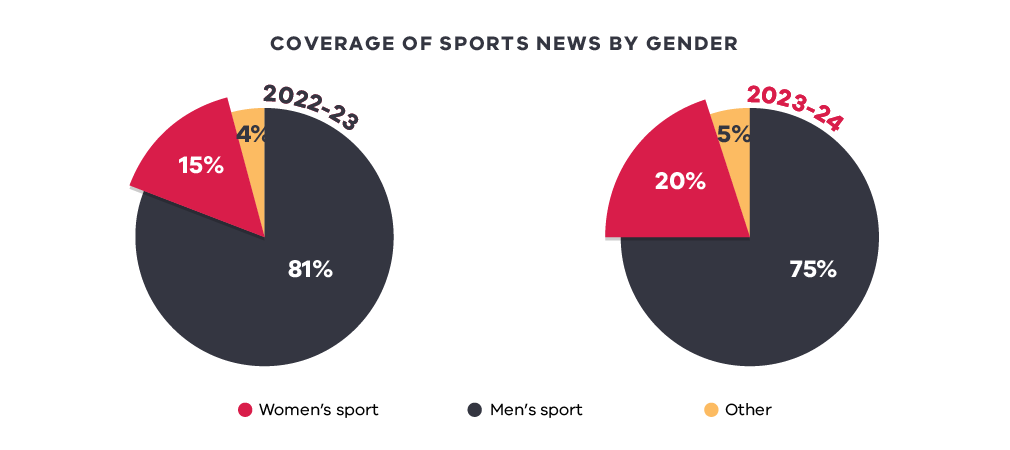
Coverage of women’s sport increased from 15% in 2022-23, to 20% in 2023-24. This is an overall increase of one third.
Of all women’s sport coverage throughout the year, 3% was on the FIFA Women’s World Cup 2023, while the remaining 17% focused on other women’s sport.
Coverage by month
Media coverage of women’s sport was consistently higher in 2023-24 than the previous year.
The proportion of coverage focus on women peaked in July and August, when the FIFA Women’s World Cup 2023 tournament was taking place. Outside of this event, November had the highest coverage peak of women’s sport.
Coverage by sport
14 of the top 20 sports increased the representation of women’s sport coverage in 2023-24 compared to the previous year. Women’s coverage represented an average of 19% of coverage across the top 5 sports.
Football (soccer) saw a rapid jump from 20% coverage focused on women in 2022-23 to 36% in 2023-24 largely due to the FIFA Women’s World Cup.
Coverage by women’s and men’s sport
Team sports continued to receive the highest share of voice for coverage across women’s and men’s sport.
Football (soccer) led the charge with 28% (doubling its coverage from 2022-23), while cricket increased its share of coverage for both men and women. Australian rules football remained high across both men and women.
Coverage by sporting team
The Matildas were the only women’s team to feature within the top 10 for share of coverage across sporting teams, with men’s AFL teams dominating in news stories.
Findings on portrayal
Despite signs of improvement, there was a continued lack in depth of coverage for women’s sport compared to men’s sport, while men athletes continued to have more space for advocacy in sport than women.
Women were more likely to be described as ‘quiet achiever’, ‘hard worker’ and ‘punching above their weight’. But there was also a shift with more women being described as talented, match-fit and having high integrity.
Findings on media
Coverage of women’s sport increased across all media types – print, online, TV news and radio news – with print continuing to be the strongest platform for coverage of women’s sport.
Bylines
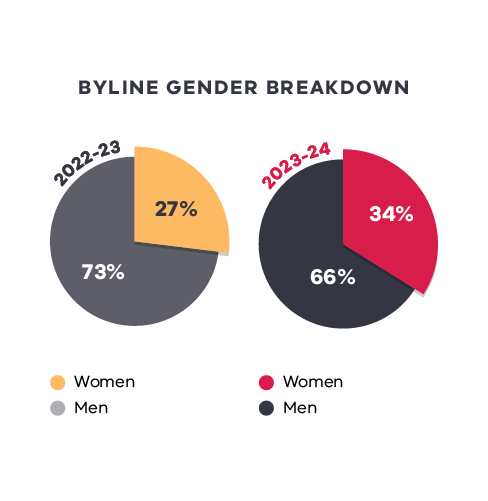
There was an increase in women’s opportunities as journalists or presenters of sports news, with 34% of bylines by women in comparison to 27% in 2022-23.
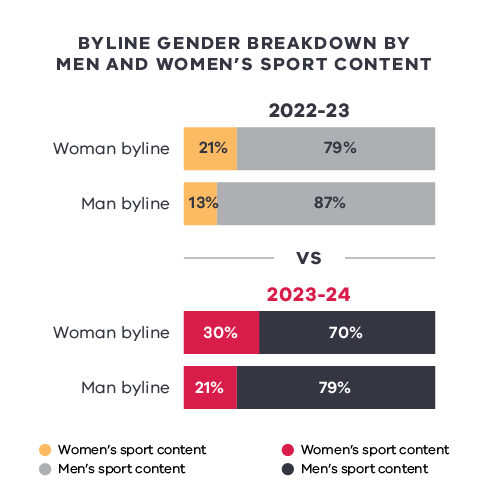
Women journalists continued to lead reporting of women’s sport, and were 42% more likely than men journalists to report on women’s sport. However, there was a 62% increase in sports news stories on women’s sport contributed by men journalists or presenters compared to the previous year.
 |  |
|---|
Sources
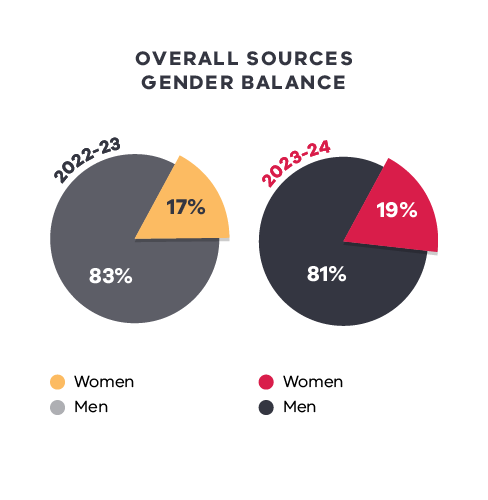
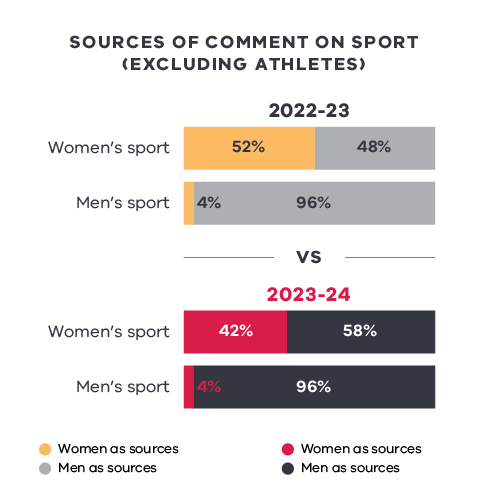
Women continued to be significantly underrepresented when it came to being a source of comment on sport. In fact, men were 15 times more likely to comment on women’s sport compared to women commenting on men’s sport (excluding comments by athletes).
 |  |
|---|
Media organisations
Most of the top 10 media organisations recorded improvements in coverage of women’s sport, compared to the previous year.
Opportunities for women journalists and presenters of sports news increased across the majority of major media organisations.
Why does this matter?
This research shows that we can see a positive shift in the representation of women in the sports media landscape in Victoria, but there is still more work that needs to be done to level the playing field for women and girls, both in sport and media.
Having a strong representation of women and girls in all areas of sport, including through sports media, is imperative in creating change at both the elite and community levels of sport.
This study shows the importance of striving for equality in the reporting of sports media and reduce the visibility gap for women in sport in Victoria.